SIMSA’s voice is established in Ottawa – in fact, it’s a requested voice.
Firstly, when SIMSA’s Executive Director – Eric Anderson – opened his email on the morning of Wednesday April 22nd (the day after the Food, Fuel, and Fertiliser event in Regina and the week after the Mining Forum), there was an email from Canadian House of Commons’ Standing Committee on Industry and Technology inviting him to appear before the committee in the context of its study of Impacts of U.S. Tariffs on Canada’s Metallurgical and Advanced Manufacturing Sectors. He was to appear Thursday at 9:00 am (the next day). They also asked for his speaking notes that same day – and the event is televised.
So, he appeared virtually before them given the short notice. The broadcast video of his opening statement is HERE and the transcript is HERE.
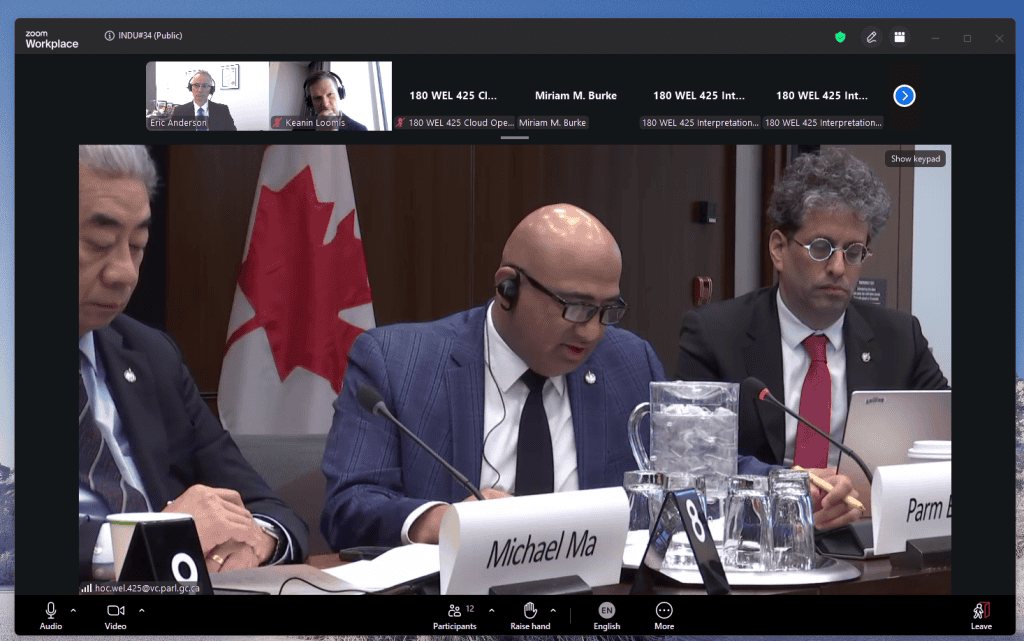
How it looked from SIMSA’s end
During the question portion, he was asked about SIMSA’s nuclear work and Federal funding. So, he thanked the Government of Canada for their great work which has largely insulated SIMSA members from the current tariff issues, stated we build big things and supply chains – such as BHP’s $18-billion Jansen project – asked for a Major Projects and Defence office be established in Saskatchewan (as we have done in person several times), and then moved on to what we do in nuclear.
Additionally, SIMSA has been communicating with several Federal Government persons over the past year or so. At the beginning of February, we had 22 meetings with over 40 persons in Ottawa, including numerous MPs, Deputy Ministers, etc. Several of these persons asked us to describe how best to do major project procurement – from the suppliers’ perspective – on a high level. This would include not only work in the resource sector, but also nuclear power and defence. This ask, stemmed from our work with companies such as BHP.
SIMSA submitted a document stating “Our members build big, and we build big supply chains.” We stated that as Canada strives to obtain sovereignty in and expand its defence and critical minerals supply chains, as well as embark on a significant nuclear power and major projects build, the question of ”How do we do all of this?” comes to the forefront. We have the capabilities and capacity to build these items, what we need is the process to orchestrate the players. The Saskatchewan Industrial and Mining Suppliers Association (SIMSA) is a model on how this can be done.
We then used the example of how we assisted the world’s largest mining company – BHP – create a supply chain for and then build the largest project they have ever built – the $18B Jansen Potash Mine.
We stated that we have proven that to successfully utilise local supply chains, major project procurement must engage – face-to-face – with local suppliers at the project conceptualisation stage. In that manner, local suppliers can be designed into the project, and not be designed out of it via early design choices that limit supplier options. Then, as the project is developed, local suppliers must have frequent access to design, management, and procurement persons. This two step process, allows local suppliers the choice of participating or not, based upon current and accurate information, and to participate. Finally, the thorough debriefing of unsuccessful bidders is a critical step, as it is a critical educational tool.
Finally, we noted that local purchasing in the resource sector, is the same as “sovereignty” on national items. Further, local can be in reference to within a province or a country.
The full major project procurement whitepaper is HERE.
So, SIMSA’s previous meetings with and visits to Ottawa, have resulted in SIMSA being a requested voice in the development of Federal policies.